Could artificial intelligence be creating the next big Wall Street bubble?
What is happening with the technology giants reminds me of a period that the American market has never forgotten: 2008.
ESTÉFANO'S COLUMN · ESTÉFANO SANTOS · 7 MIN

Speak up, gang!
There is something happening in the American market that is catching my attention.
And look, I've seen a lot in these more than ten years operating the Nasdaq.
The whole world is talking about artificial intelligence. It's a company investing billions, building data centers, buying chips, announcing gigantic projects. It seems like everyone wants to get into this race.
And I have no doubt that artificial intelligence is changing the world.
But do you know what question I ask when I look at all this?
Where is so much money coming from? And, most importantly, when will this money start to come back?
Because, guys, it's one thing to have revolutionary technology. Another thing is that this technology generates enough money to justify everything they are investing in it.
And Wall Street knows very well the difference between these two things.
This reminds me of a story we've seen before
There is a term in economics called Minsky Moment.
The name seems complicated, but I'll explain it in a simple way.
Imagine a market that starts to rise, rise, rise. Everyone making money, companies increasing in value, banks lending, investors becoming increasingly confident.
Then people start to believe that it will never end.
And do you know what happens?
They begin to take greater and greater risks. They borrow more money, invest more, make bigger bets.
Until a time comes when someone looks at that bill and asks:
Wait a minute. Who will pay for all this?
When confidence starts to disappear, the market can turn very quickly.
It was an important part of what happened in 2008.
At that time, the problem was in the American real estate market. Banks lent money to people who were often unable to pay. These debts were transformed into financial products and spread across the market.
As real estate rose, it seemed like everything was fine.
Until it wasn't anymore.
And when that collapsed, it wasn't just the banks that suffered.
It was the worker, it was the family, it was the retiree who saw part of their assets disappear.
Now pay attention.
I'm not saying that artificial intelligence will bring about another 2008.
But I am saying that there are signs of risk that cannot be ignored.
Money is rushing into artificial intelligence. But until when?
Look at the size of the companies involved in this race.
Microsoft, Google, Amazon, Meta and other giants are putting absurd amounts of money into artificial intelligence infrastructure.
And these companies are not small. Many have extremely profitable businesses and the financial capacity to invest.
But that doesn't eliminate the main question.
How long will it take for all this investment to bring the expected return?
Because the market works with expectations.
If a company promises to grow a lot, the share price may rise before that growth even appears on the balance sheet.
But, if the result doesn't arrive, the market starts to demand it.
And when Wall Street decides to charge, guys, it doesn't send advance notice.
The price simply starts to react.
That's why I say: not every extraordinary company is necessarily a good investment at any price.
You could be looking at a technology that will change the world and still pay too much for a share.
They are two completely different things.
And there's another problem with this story
We can't just look at artificial intelligence.
We have to look at the whole picture.
American interest rates, inflation, public debt, international conflicts, oil, dollar...
All of this speaks to the market.
When the cost of money increases, companies need to think twice before taking out credit. Families feel the weight of financing. Consumption may lose strength.
And when consumption loses strength, this can appear in companies' results.
Now imagine all this happening while the market expects gigantic profits from artificial intelligence.
Do you realize how delicate the situation is?
That's why I follow the macroeconomic scenario every day.
No because a piece of news will tell me exactly where to buy or sell.
But because it helps me understand the environment in which I am operating.
And what would I do in a market like this?
Class, here's something I've been saying to my students for years.
The market has no obligation to do what you think it will do.
You can study, follow the news, listen to analysts, understand economics...
But, when the market opens, the price is in charge.
And that's exactly where a lot of people lose money.
The guy sees the Nasdaq falling and thinks: now it's cheap, I'm going to buy it.
Then buy it.
The market falls further.
He buys it again.
And, when he realizes, he finds himself in a much bigger position than he should be and doesn't know where to get out.
Or the opposite happens.
The market skyrockets, he is afraid of missing the opportunity, enters late and ends up buying just when the movement loses strength.
This is very common.
And do you know why?
Because many people enter the market without having a complete plan.
She knows where she wants to go, but she doesn't know what to do if the operation starts going against her.
It's not enough to know how to enter. You need to know where you intend to leave, how much you accept to risk and when the scenario stops making sense.
It is exactly this thought that is behind my methodology, the Confirmation Clock.
I developed this reading throughout my experience in the American market, studying price behavior and seeking more objective criteria for operations.
Today, this methodology is also represented in an indicator.
It shows entry signals, a green target line, a yellow attention line and a red stop line.
In other words, the student can view important references of the operation directly on the graph.
This does not mean that all entries will be successful.
They won't.
But it helps to take the decision out of the field of improvisation and into a process that the student needs to learn to follow.
And for me, that's a huge difference.
I'm not worried about guessing the next crisis
I'm going to tell you something.
Every time the market starts to get more nervous, someone appears saying that the biggest crisis in history is coming.
Others say it's the biggest buying opportunity of the decade.
And everyone seems to be sure of something.
I don't work like that.
I don't know if artificial intelligence will trigger a big correction in the Nasdaq.
I also don't know if companies will surprise the market and continue to grow much more than people imagine.
What I know is that, when there is a lot of money involved, a lot of expectations and a lot of uncertainty, the market can show strong movements.
And strong movements require even more respect for risk.
Those who trade futures contracts know that it is possible to look for opportunities both at highs and lows.
But you also know, or at least you should know, that a poorly managed operation can compromise the results of several positive operations.
That's why I insist so much on technique, discipline and risk management.
Because there's no point getting it right several times and returning everything in a single operation.
Now, let me ask you a question
Do you really believe that all these companies will be able to turn the billions invested in artificial intelligence into the profits that Wall Street is waiting for?
It can happen.
But it could also be that the market is anticipating results that will take much longer to arrive.
And that's where we need to pay attention.
I continue to believe in the potential of artificial intelligence.
But believing in a technology does not mean turning a blind eye to the financial risks that exist around it.
The market is not a place for fans. It is a place for reading, strategy and decision-making.
And if there's one thing I've learned in my more than ten years of operating the Nasdaq, it's that you don't need to have an opinion on everything.
You need to know what to do when the market shows a scenario that is within your strategy.
The rest is expectation.
And expectations, class, don't pay the bill.
Now tell me: do you believe that artificial intelligence is creating a new bubble on Wall Street or are we just at the beginning of a revolution that will grow a lot?
I want to know your opinion.
Estéfano Santos has been a trader in the American market for over 10 years and creator of the Confirmation Clock methodology.
Transparency notice: this column is written by Estéfano Santos, from X-Trader Academy, the company that maintains The X-Trader News. The text presents scenarios and opinions, is informative and educational in nature and does not constitute an investment recommendation or prediction of results.
Automatically translated from Portuguese.
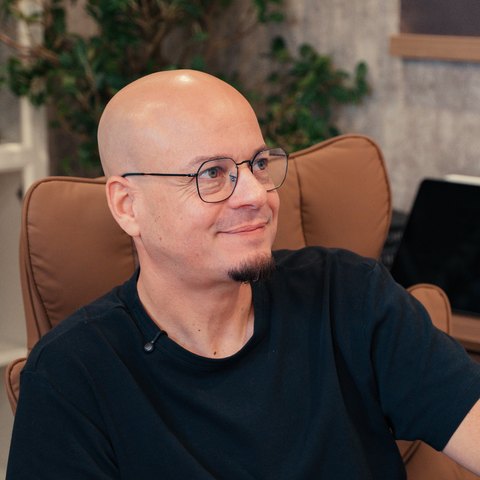
ESTÉFANO'S COLUMN
Estéfano Santos · founder of X-Trader and a Nasdaq Futures trader for over 10 years
In the X-Trader program, Estéfano teaches the method he uses every day, with risk management before any trigger.
DISCOVER THE PROGRAM ↗